4.7. Redshift Distribution Priors
Phosphoros implements the \(\mathcal{P}(z,T|m_0)\) prior, i.e. the probability that a galaxy of apparent magnitude \(m_0\) is at redshift z and belongs to the type \(T\) (see Methodology: Redshift Priors). It follows that
where \(p(T|m_0)\) is the galaxy type fraction as a function of magnitude and \(p(z|T,m_0)\) is the redshift distribution for galaxies of magnitude \(m_0\).
Phosphoros follows the procedure developed in Benitez 2000 [Benitez00] and implemented in the Le Phare code [IlbertArnoutsMcCracken+06]. Three different galaxy types are considered according to the \(B-I\) color: early types (E/S0) if \(B-I>1.285\), irregulars if \(B-I<0.945\) and spirals (Sbc, Scd) otherwise. The color is computed for each restframe SED template in the grid of models, without intrinsic reddening.
The apparent magnitude \(m_0\) of modeled SED templates is then computed with respect to the \(I\) filter, for each model of the grid.
For \(m_0(I)<20\), we set the prior equals to 1 for \(z\le1\) and 0 otherwise.
For \(m_0(I)>20\), we assume that:
the spectral type prior can be parametrized as:
\[p(T|m_0)=f_t\,e^{-k_t(m_0-20)}\,,\]with \(t=1\) for early types and \(t=2\) for spirals. The fraction of irregulars (\(t=3\)) is automatically determined by the other two fractions, \(p(3|m_0)=1-p(1|m_0)-p(2|m_0)\).
The redshift distribution prior is:
\[p(z|T,m_0)=C_t z^{\alpha_t} \exp\bigg\{-\bigg[\frac{z}{z_{mt}(m_0)}\bigg]^{\alpha_t}\bigg\}\,,\]giving an exponential cutoff in the galaxy distribution at high redshifts. The median redshift, \(z_{mt}\), is chosen to have a linear dependence on magnitude:
Warning
The exponential cutoff at high redshifts in the redshift distribution prior is maybe too strong and it will be updated with a power-law cutoff in the future Phosphoros versions.
In total, there are 16 free parameters \(\{\alpha_t,\,z_{0t},\,k_{mt},\,f_t,\,k_t,\,C_t\}\). The values of free parameters used in Phosphoros are reported in Table 4.2 (they are updated with respect to the ones provided by Benitez 2000 and Ilbert et al. 2006). Users can change them in the CLI mode.
Spectral Type |
t |
\(\alpha_t\) |
\(z_{0t}\) |
\(k_{mt}\) |
\(f_t\) |
\(k_t\) |
\(C_t\) |
|---|---|---|---|---|---|---|---|
E/S0 |
1 |
2.46 |
0.431 |
0.091 |
0.30 |
0.4 |
0.8869 |
Sbc, Scd |
2 |
1.81 |
0.390 |
0.100 |
0.35 |
0.3 |
0.8891 |
Irr |
3 |
2.00 |
0.300 |
0.150 |
0.8874 |
The spectral type fractions at \(m_0=20\) are therefore 30% E/SO, 35% spirals, and 35% irregulars.
4.7.1. Redshift Priors in the GUI
Redshift distribution priors are enabled in the GUI by checking N(z)
Prior in the 3. Prior sub-panel of the Compute Redshifts
window (see Fig. 4.5). Clicking on the Configure N(z)
Prior a popup window opens where users have to select the B and
I filters from the database. These filters are needed to compute the
B-I color of modeled templates and so their type.
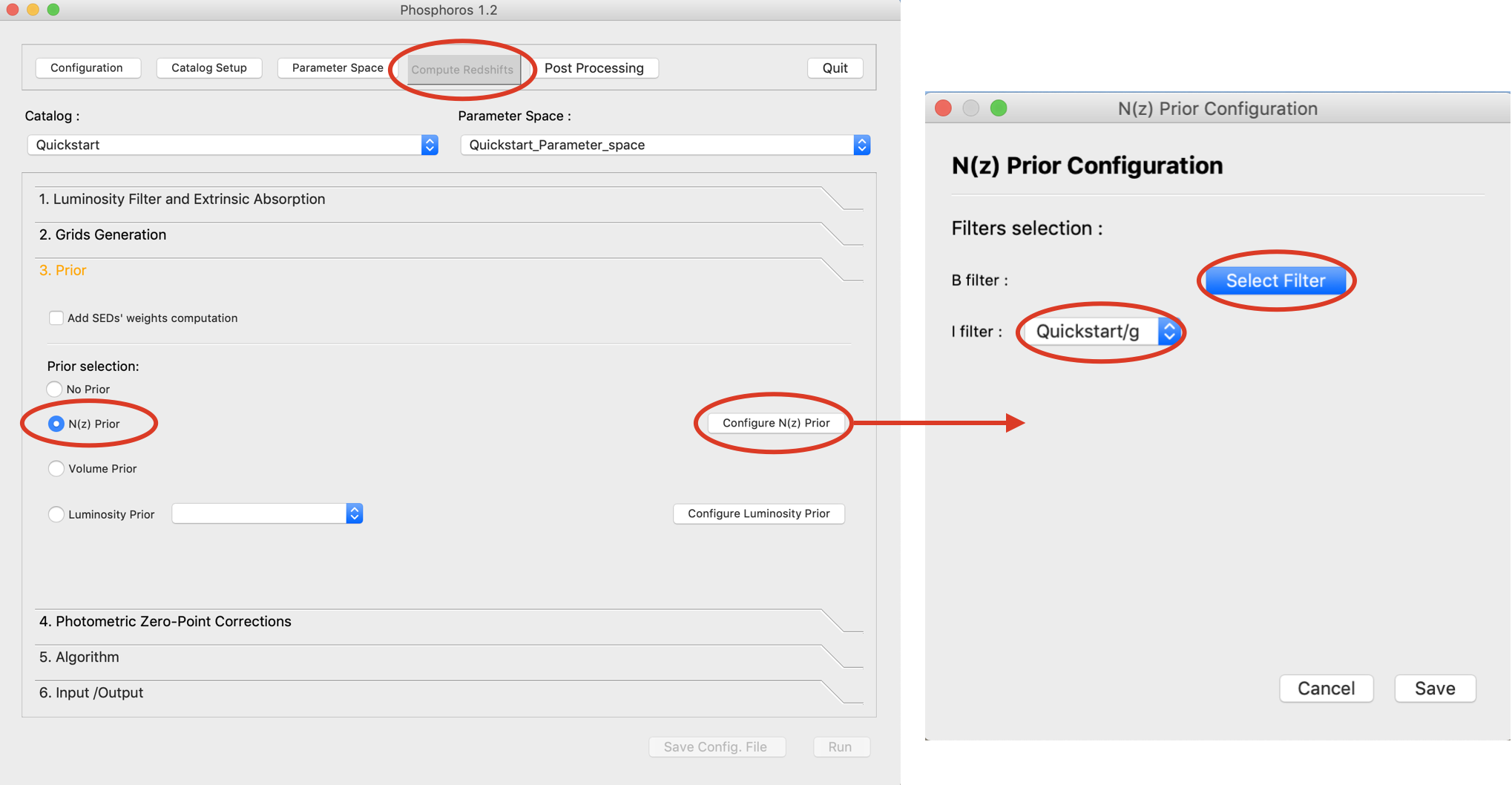
Fig. 4.5 Introducing redshift priors with the GUI
Note
The values of the parameters of the redshift distribution priors (Table 4.2) cannot be modified in the GUI.
Warning
The I filter must be part of the filters selected to compute photometry. This is not the case for the B filter.
4.7.2. Redshift Priors in the CLI
Redshift distribution priors are enabled in the CLI by setting the action
parameter --Nz-prior=YES (the default is NO) of the
compute_redshift action.
Qualified names (below the AuxiliaryData/Filters directory) for
the B and I filters are required through the options:
Nz-prior_B_Filter=<name>
Nz-prior_I_Filter=<name>
The I filter is used to compute the apparent magnitude of galaxies and must be part of the selected photometric filters.
The values of the parameters of the redshift distribution priors (Table 4.2) can be changed by users with the option:
Nz-prior_<p>_T<i>=<value>
where <p> can be z0 (i.e. \(z_{0t}\) in the above
equation), Km (\(k_{mt}\)), alpha (\(\alpha_t\)),
K (\(K_{t}\)), f (\(f_t\)) and cst (\(C_t\)),
while i refers to the galaxy type (\(t=1,2,3\), apart from
f and K where \(t=1,2\)). For example, the option:
Nz-prior_z0_T2=0.5
modifies the spiral galaxies parameter \(z_{02}\) to 0.5.
An effectiveness value different from 1 can be set with the command
option --Nz-prior-effectiveness (see Prior effectiveness).
- Benitez00
Narciso Benítez. Bayesian Photometric Redshift Estimation. ApJ, 536(2):571–583, Jun 2000. arXiv:astro-ph/9811189, doi:10.1086/308947.
- IlbertArnoutsMcCracken+06
O. Ilbert, S. Arnouts, H. J. McCracken, M. Bolzonella, and et al. Accurate photometric redshifts for the CFHT legacy survey calibrated using the VIMOS VLT deep survey. \aap , 457(3):841–856, Oct 2006. arXiv:astro-ph/0603217, doi:10.1051/0004-6361:20065138.